A healthcare QR code is a link carrier, so it can open public information, a booking page or a patient portal, but it provides no privacy, identity or compliance guarantee of its own. Every safeguard has to live in the service behind the scan: who may open it, what it collects, who can see it, and how it is monitored.
This guide is the governance view. It covers how to classify a healthcare use, what a printed code can leak, how a scan should hand off to an authenticated service, why tracking tools need special care, how to review vendors, and what to do when a sign is tampered with. For the patient-facing side (waiting-room posters, wayfinding, discharge instructions and the front desk), read the companion piece on QR codes for clinics and hospitals.
How sensitive is the page behind your healthcare QR code?
Start with the destination, not the symbol. The same black-and-white square can open a parking map or a lab result, and the controls required for those two are very far apart.
| Use | Typical sensitivity | Safer pattern |
|---|---|---|
| Hours, directions, services, education | Public | Verified public page on the provider domain |
| Generic appointment request | May collect personal or health data | Approved booking service with appropriate safeguards |
| Patient intake or consent forms | Sensitive | Authenticated or risk-reviewed portal workflow |
| Patient-specific record or result | Highly sensitive | Short-lived link plus strong identity and authorization controls |
| Clinical specimen, medication, or patient identity | Safety critical | Validated clinical barcode system and human safety checks |
| Bill payment | Financial and identity data | Approved payment portal with verified domain |
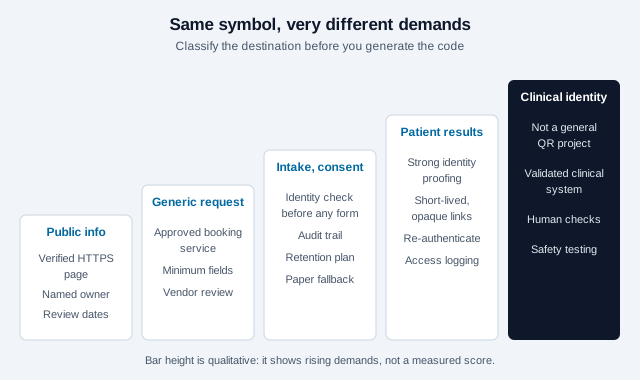
A general-purpose QR generator suits a tested public URL. It is not a patient-identity, specimen, medication-administration, consent, electronic-signature, authentication or medical-record system.
What does HIPAA mean for a QR code?
HIPAA applies in the United States to defined covered entities, business associates and protected information under specific rules. Other federal, state, local, professional, contractual and international requirements may apply as well, so qualified privacy, security and legal staff should decide the scope.
HHS describes the Security Rule as requiring administrative, physical and technical safeguards for the confidentiality, integrity and availability of electronic protected health information, including access control, audit controls, integrity, authentication and transmission security. It also expects a documented risk analysis and ongoing evaluation. A static link or an "encrypted QR" claim answers none of those items. HHS publishes proposed changes to the Security Rule separately, so confirm the version in force at design time and at each scheduled review.
The minimum-necessary standard adds a design constraint. In general, covered entities must limit certain uses, disclosures and requests for protected health information to what the purpose needs, subject to stated exceptions. A digital form with room for extra demographics or marketing consent is not a reason to collect them.
What can a printed healthcare QR code leak?
A QR code is a readable string. Anyone who photographs a poster, a letter, a wristband or a screen can decode the string and open the address, and a forwarded photo carries the same ability. So the payload must be safe for a stranger to read.
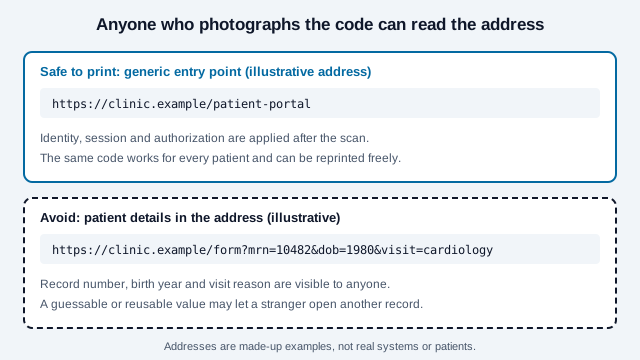
Keep out of any public payload: protected health information, credentials, diagnoses, medication data, appointment details, record numbers and reusable access tokens. Also watch the query string of the destination. Page titles, form-field values and event names can end up in logs and in third-party tools, which makes a harmless-looking URL parameter a disclosure path.
How should a scan reach a patient-specific service?
The safest public symbol opens a generic entry point. After the page loads, the system applies the organization's approved identity, session, authorization, timeout and record-handling controls. A patient-specific link is sometimes unavoidable, for example a pre-visit form tied to one appointment. In that case use an opaque, hard-to-guess token with narrow scope and a short lifetime, secure transport, server-side authorization, revocation, rate limiting and monitoring. Avoid sequential identifiers, and never let obscurity be the only control.
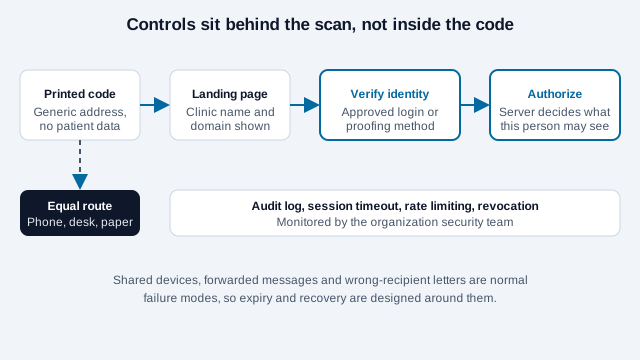
Assume that printed codes, letters, labels and messages will be photographed, forwarded, discarded or delivered to the wrong person. Design expiry and recovery for those cases, and re-authenticate before showing sensitive records or allowing consequential changes.
Before deploying an intake or consent workflow, map every field and why it is needed, where data travels and is stored, which staff roles and vendors can access it, how submissions reach the correct record, how corrections and consent withdrawal work, what audit evidence is recorded, and how downtime and misrouting are handled.
Should a healthcare QR destination use analytics or ad pixels?
Treat third-party trackers on patient-facing pages as a risk until a privacy review says otherwise. HHS's Office for Civil Rights published a bulletin on online tracking technologies, and on June 20, 2024 a federal court in the Northern District of Texas (American Hospital Association v. Becerra) vacated the part of that bulletin that treated an IP address plus a visit to an unauthenticated public page as a HIPAA violation. HHS then withdrew its appeal, according to law-firm and trade-press coverage. Commentary differs on how far the ruling reaches, and it did not remove the underlying concern about authenticated pages, where trackers can capture identifiers tied to health information. Check the current HHS guidance page and ask counsel before relying on any reading.
If measurement is needed, define a narrow purpose, minimize data, keep public education separate from authenticated care, apply the right contracts, restrict access and set retention. A redirect request is not proof of a patient visit, consent, a completed form or a clinical outcome, so do not report it as one.
What should you ask a QR or portal vendor?
A vendor may only generate an image, or it may operate redirects, analytics, forms, storage, identity, messaging or support. Write down which of those it actually does, then review the matching items.
| If the vendor... | Ask about |
|---|---|
| only draws the image | Whether it keeps the destination URL or any scan data, and whether the file works offline |
| runs the redirect | Uptime, domain ownership, what happens if you leave, and what each scan request logs |
| hosts forms or messages | Business associate agreement status, data location, subprocessors, encryption, retention and deletion |
| supplies analytics | Which identifiers it receives, how long it keeps them, and whether you can switch it off on patient flows |
| handles identity | Proofing method, multi-factor options, audit logging and incident notification |
HHS notes that business associates can be directly liable for specified HIPAA duties, but a signed agreement does not fix a badly designed workflow. Where a vendor is a business associate, the agreements and obligations still need to be addressed.
Why is clinical identification a different project?
A successful decode proves only that a symbol yielded data. It does not prove that the label is on the right patient or item, that the record is current, or that the proposed action is clinically appropriate. The Joint Commission's patient identification goal calls for at least two patient identifiers when providing care, and its guidance has accepted barcoding that carries two or more person-specific identifiers. That is a validated clinical system with exception handling, not a clinic's own QR project.
The same logic applies to devices and drugs. In the United States, FDA's unique device identifier system is built on GS1 and other accredited standards, and vendor guidance reports that GS1 DataMatrix is the usual carrier for hospital scanning. A plain QR code that links to a web page is not a substitute for the regulated identifier (the sources here are vendor blogs, so confirm against FDA and GS1 documents). Use QR codes for information that supplements the label, such as electronic instructions, never as the only control for identity, specimens, medication administration, implants or prescriptions.
What accessibility duties sit behind the code?
Scanning must not be the only route to care, forms, results, bills or instructions. Offer staffed, telephone, paper, kiosk, portal or interpreter options suited to the service. The destination should use real text, meaningful labels, keyboard access and layouts that adapt to small screens and zoom, following W3C guidance. Test the full flow with assistive technology, not just the symbol.
For recipients of HHS funding, a web accessibility rule under Section 504 sets WCAG 2.1 Level AA as the technical standard. Law-firm summaries report that a May 2026 interim final rule moved the compliance dates to May 11, 2027 for recipients with 15 or more employees and May 10, 2028 for smaller ones. Verify the dates in the Federal Register and with counsel, because they have already moved once. The companion QR code accessibility guide covers the physical side of the sign.
How do you stop and respond to sticker tampering?
The FBI has warned that malicious QR codes can send people to pages that ask for personal or financial information or install unwanted software. A fraudulent sticker in a clinic exploits patient trust, and the QR code scams guide explains how the attack works.
- Print the organization name and domain beside every code.
- Use integrated or tamper-evident signs, and inspect waiting rooms, parking signs, bills and handouts.
- Train staff to recognize overlays and unexpected domains.
- Tell patients the organization will not ask for passwords or one-time codes through an unexplained scan.
- Keep a reporting and rapid-removal procedure.
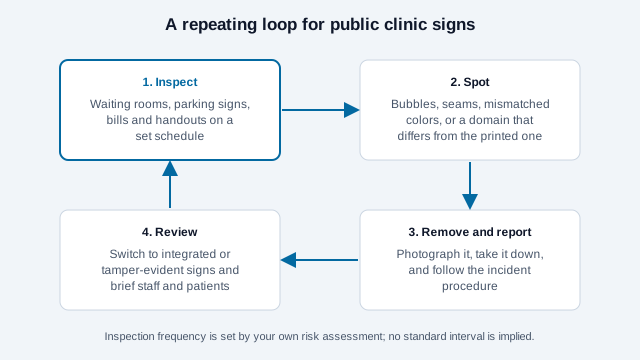
Monitor destination ownership, certificates, redirects, form routing and access logs as well. Define escalation for a wrong-patient submission, exposed token, malicious sticker, lost device or incorrect clinical content, preserve evidence, and follow the organization's incident and breach-assessment procedures.
What does a typical mistake look like?
Picture a small clinic that prints a poster for the waiting room. The QR code opens a pre-visit questionnaire, and to save patients typing, the front desk emails each patient a personalized version of the link containing their record number. A patient forwards the email to a relative for help, the relative's phone saves it in a shared notes app, and the questionnaire page loads an advertising pixel that logs the full URL. Three small decisions, each reasonable alone, have combined into a disclosure path.
Fixing it takes no new technology. Replace the personalized link with a generic code plus a login, remove the pixel from the page, shorten any remaining token lifetime, and add a printed phone number for patients who prefer not to use the form. The review that would have caught it is the data-flow map described above.
Healthcare QR deployment checklist
- The use is classified as public, sensitive, patient-specific, financial or clinical.
- Qualified teams determined the applicable legal and regulatory scope.
- A documented risk analysis covers the full workflow and every vendor.
- No protected health information, credential or reusable patient token appears in any public payload or URL.
- Authentication, authorization, audit, integrity and transmission controls were tested.
- Third-party trackers are absent from patient flows or have been reviewed and contracted.
- Data collection is limited to the stated purpose.
- The whole journey is accessible and has an equal non-phone route.
- Clinical identity and safety-critical uses rely on validated systems and checks.
- Signs are labeled and inspected, and an incident process exists.
- Downtime, reconciliation, retention, vendor exit and review dates are rehearsed.
For a risk-reviewed public destination, create the QR code, label the organization and purpose beside it, and run the printed result through the scannability tester. Choose a static or dynamic code deliberately: a static code never expires, while a dynamic one adds a redirect service that you must review as a vendor.
Which privacy questions need your counsel, not this checklist?
Some questions depend on facts the checklist cannot see: whether your organization is a covered entity, which state privacy laws apply to patients in your area, whether your portal vendor's subprocessors are acceptable, and how the tracking-technology rules develop after the 2024 ruling. Treat those as open items for your privacy officer and counsel, and put review dates on them.
This article is general information, not legal, clinical or compliance advice. Requirements differ by country, state and organization type and change over time, so confirm them with your regulator or a qualified adviser before deployment.
References
- HHS: HIPAA Security Rule
- HHS: summary of the HIPAA Security Rule
- HHS: minimum necessary requirement
- HHS: risk-analysis guidance
- HHS: business-associate liability
- HHS OCR: use of online tracking technologies by HIPAA-covered entities
- Proskauer: OCR stands down and withdraws its appeal of the tracking-bulletin ruling
- Venable: federal court strikes part of HHS tracking guidance (June 2024)
- Clinician.com: Joint Commission advisory on accurate patient identification
- Feldesman: HHS extends web and mobile accessibility compliance deadlines
- Uniqode (vendor): QR codes for medical devices, FDA UDI and GS1
- W3C WAI: accessible design tips
- FBI IC3: cybercriminals tampering with QR codes to steal victim funds (January 2022)