A static QR Code cannot count scans by itself. To measure a campaign, either add UTM parameters to a web destination and analyze visits in your consent-aware analytics setup, or route the code through a redirect service that records requests before forwarding visitors. These methods observe different points and neither automatically counts unique people.
Use separate, documented URLs for each physical placement, test the complete redirect and landing-page path, and judge the campaign by a meaningful outcome, not by a headline “scan” number alone.
What can QR tracking actually measure?
| Measurement point | What it can show | What it cannot prove |
|---|---|---|
| Redirect request | A request reached the redirect provider | A unique person or completed page visit |
| Landing-page analytics | A measured visit with campaign attributes | Every attempted scan |
| Key event | A configured action such as a submitted form | Revenue unless reconciled to business records |
| Order or CRM record | A business outcome tied to an identifier | Perfect attribution without a sound data design |
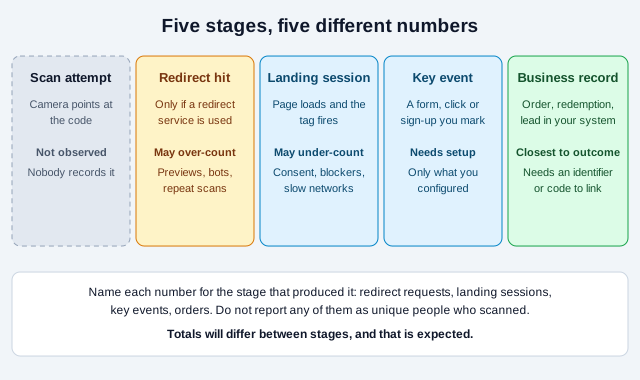
Repeat scans, link previews, security tools, bots, staff tests, and refreshes can add requests. Consent choices, ad or script blocking, network failure, browser closure, and tagging errors can prevent analytics collection. Report the observed metric by its real name.
Vendor help pages describe the inflation risk directly. One QR provider says a reader app can request a link twice, first for a preview or security check and then when it forwards the user. Another separates total requests from unique visitors, and a third lists link-preview bots among the sources of extra scans. These are vendor descriptions of their own products, not an industry standard, so check how any tool you use defines total, unique and bot-filtered counts.
Method 1: UTM-tagged destination URLs
UTM parameters describe the campaign source, medium, and name when a tagged link opens. Google states that these values can populate traffic-source dimensions and appear in the GA4 Traffic acquisition report.
| Parameter | Purpose | Example |
|---|---|---|
utm_source | Specific source or placement family | store_poster |
utm_medium | Consistent channel category | offline_qr |
utm_campaign | Marketing initiative | autumn_membership |
utm_content | Creative or individual placement | front_window_a |
utm_id | Internal campaign identifier | cmp_2047 |
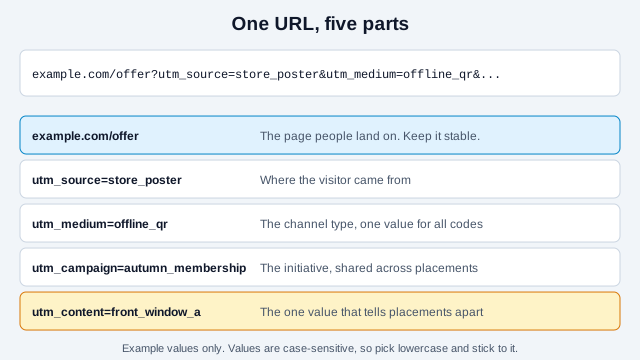
Google’s URL builder page says to always use utm_source, utm_medium and utm_campaign whenever you add parameters, and strongly recommends utm_id as well. Missing values show as “(not set)” in reports. Values are case-sensitive, so google and Google are different sources, and Google’s best practice is lowercase throughout. Decide the naming convention before generating codes, and keep a campaign registry with the final URL, placement, owner, dates, artwork version and expected outcome.
Create a trackable static QR Code
- Choose a fast, mobile-accessible HTTPS landing page that you control.
- Confirm the site's analytics and consent configuration is appropriate for the intended audience and jurisdictions.
- Create a UTM naming plan and reserve one
utm_contentvalue for each placement or creative you need to compare. - Build the complete destination URL with the UTM builder or Google's Campaign URL Builder.
- Open that URL and verify that parameters survive any redirects.
- Encode the complete URL with the URL QR Code generator.
- Test the final code and confirm a test visit appears in the intended analytics property and report.
- Record the test traffic so it can be excluded or annotated during analysis.
If the printed URL is long or creates a dense symbol, use a stable short path on a domain you control. Do not choose an unowned shortener solely for smaller artwork; losing the redirect account or domain can break every printed code.
One placement, one attributable URL
If the same exact URL appears on a storefront sign, table tent, package insert, and direct-mail card, landing-page analytics cannot tell which physical object produced a visit. Use distinct utm_content values, or separate controlled short paths, for the placements you need to compare.
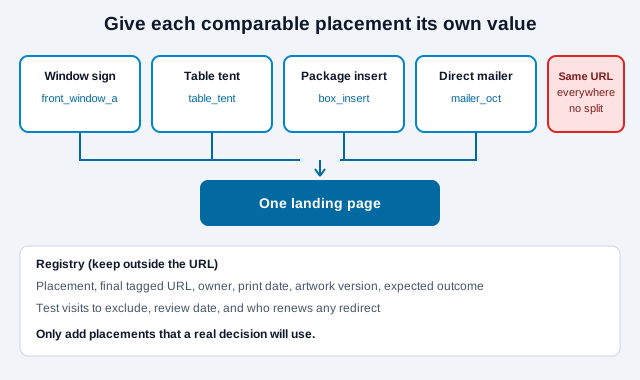
Do not create excessive variants that no decision will use. A useful plan might distinguish store, city, artwork, or mail version. A wasteful plan generates a unique code per leaflet without the staff, sample size, or decision process to analyze it.
Find QR campaign traffic in GA4
Google's current guidance places session-level campaign analysis in Reports → Acquisition → Traffic acquisition. Use dimensions such as Session source, Session medium, Session campaign, or Session source / medium. Exact navigation and available dimensions can change as products evolve.
Check at least:
- sessions or engaged sessions from the tagged campaign;
- the landing page and device experience;
- configured key events relevant to the campaign;
- outcomes by placement or creative;
- conversion rate rather than traffic alone; and
- reconciled orders, leads, redemptions, or registrations where appropriate.
UTM data describes acquisition; it is not a dedicated scan counter. Google’s page on direct traffic says visits can be labeled “(direct) / (none)” when links lack UTM parameters, when redirects (including HTTPS-to-HTTP) strip them, and when visitors arrive from offline documents. It does not mention QR codes by name, so treat a code without tags as likely to land in the same bucket and test the deployed chain instead of assuming attribution works.
The Traffic acquisition report also reads session-level data. The current Google help page lists Session campaign, Session medium, Session source, Session source / medium and Session source platform, and a Key events metric that counts the events you have marked as key events. Google notes that UTM values are omitted from the landing page and query string dimension and appear in Page location instead.
Method 2: redirect-request tracking
A hosted “dynamic QR Code” normally contains a provider-controlled short URL. The provider receives a request, may record permitted metadata, and redirects the browser to the destination. Depending on the service and plan, the destination may be editable after printing.
Before using a provider, evaluate:
- who owns the short domain and what happens if the subscription ends;
- whether redirects remain active after cancellation or plan changes;
- export, retention, deletion, access, and incident-response controls;
- bot filtering and definitions for total versus unique requests;
- location precision and how it is derived;
- consent, privacy notice, and processor terms;
- redirect speed, uptime, HTTPS, and abuse controls; and
- the process for changing destinations and reviewing history.
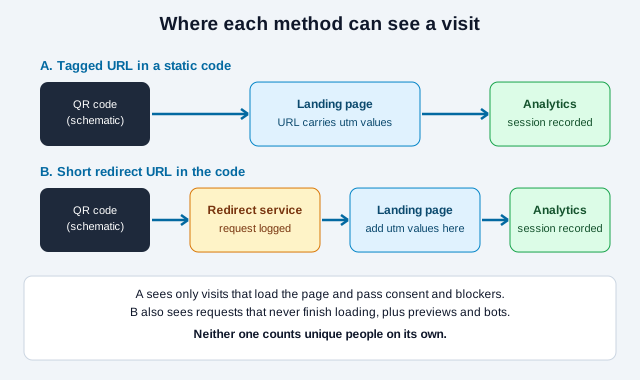
Provider analytics and GA4 will not necessarily match. They observe different stages, filter traffic differently, and may use different time zones or uniqueness windows. Reconcile trends and definitions rather than forcing identical totals.
Static UTM or hosted redirect?
| Requirement | UTM to your page | Hosted redirect |
|---|---|---|
| Campaign attribution on your measured site | Yes, when correctly implemented | Usually add UTMs as well |
| Observe redirect requests before the landing page | No | Potentially |
| Change destination after print | Only with a redirect you control | Common provider feature |
| Avoid third-party redirect dependency | Yes | No |
| Use your existing web consent and analytics controls | Yes | Also review provider collection |
For a short campaign with a stable landing page, distinct UTM-tagged static codes may be enough. For expensive long-lived print whose destination must change, use a durable redirect under organizational control or contractually evaluate a provider. Tracking alone is not a reason to surrender link ownership without review.
Measure outcomes, not vanity metrics
Define the decision and outcome before printing. Examples include completed registration, coupon redemption, qualified lead, product setup, menu order, donation, or support deflection. Configure the least amount of measurement needed to answer that question.
A basic funnel can be expressed as:
- Observed visits: measured landing sessions from a placement;
- Action rate: relevant completed actions divided by observed visits;
- Cost per action: attributable campaign cost divided by actions; and
- Business value: verified value or savings associated with those actions.
Do not interpret a low visit count until you also check distribution, visibility, print quality, call-to-action clarity, destination speed, access restrictions, and measurement health.
Privacy and responsible analytics
A QR Code does not create an exemption from privacy or consent requirements. Document the data collected by the landing page and any redirect provider, minimize it, restrict access, define retention, and provide required notices and choices. Avoid embedding names, emails, customer IDs, or other personal information in UTM parameters because URLs can appear in browser history, logs, analytics, and shared screenshots.
Google’s consent mode documentation explains that when a visitor denies consent, Google tags stop storing cookies and send pings instead, and that GA4 properties can use those pings to model some of the missing data. Under an IAB TCF consent setup, that modeling is not available. In practice, a low landing-session count can partly reflect consent choices, and the figures you see may include modeled data. See the scan privacy policy for how this site handles scan data from its own dynamic codes.
Google documents consent management and notes that denied consent can affect measurement. Measurement Protocol is an advanced server-to-server supplement to normal tagging, not a shortcut for bypassing user choices or replacing a sound web implementation.
Preflight checklist
- Campaign and outcome definitions are documented.
- Each useful placement has a consistent unique value.
- No personal or secret data appears in the URL.
- HTTPS, redirects, UTMs, consent behavior, and key events are tested.
- The landing page is fast, mobile usable, accessible, and matches the printed promise.
- The QR Code has adequate contrast, quiet zone, size, and production quality.
- Final physical proofs are tested on representative devices.
- Staff and agency test traffic is recorded.
- Redirect ownership, renewal, and end-of-campaign behavior are assigned.
- Reports use honest metric names and stated limitations.
What does a tracking mistake look like?
Look at a gym that prints one QR code, with no tags, on a window poster, 300 flyers and a membership card. After a month the analytics show 140 direct visits to the sign-up page and the owner concludes the poster “worked.” Direct traffic cannot say that. Staff also scanned the code a dozen times while testing the card, and some visitors came from the gym’s own email list.
A repaired plan uses one tagged URL per item (poster_window, flyer_street, card_member), records the staff test visits, and watches sign-ups from each value. Even then, the result describes measured sessions and form submissions, not the number of people who scanned.
What can scan tracking not settle?
- How many people saw the code and chose not to scan. No method records the scan attempt.
- Unique people. Vendors define unique visitors in different ways, and shared devices, VPNs and privacy tools can distort any count.
- Whether one placement caused a sale that also had other influences. UTM attribution is a last-touch convenience, not proof.
- Which privacy rules apply to your audience and which consent flow you need. That depends on where your visitors are and what you collect.
Start by building a consistent campaign URL with the UTM builder, create and test its QR code before committing the artwork to print, and read static versus dynamic QR codes if the destination might need to change. If a redirect will carry the code, the dynamic QR code generator and do QR codes expire explain the ownership trade-offs.
This guide is general information, not legal advice. Analytics, consent and data-protection duties vary by country and sector, so check your local rules and your analytics provider’s terms.
References
- Google Analytics: URL builders and UTM campaign parameters
- Google Analytics: traffic-source dimensions
- Google Analytics: Traffic acquisition report
- Google Analytics: direct traffic and missing attribution
- Google Analytics: user consent management
- Google Analytics: Measurement Protocol
- DENSO WAVE: QR Code area and quiet zone
- QR Planet Help: Why are QR Code scans counted twice? (vendor)
- Scanova Support: Bot scans (vendor; page could not be fetched, cited from a search summary)
- Linkly: QR code analytics guide (vendor; cited from a search summary)