An “invisible QR code” is not one standardized consumer technology. The phrase describes experimental or specialized ways to hide a machine-readable pattern from ordinary human vision while revealing it to a compatible camera, illumination source, material, or image-processing system.
A normal phone camera cannot be assumed to scan these codes. Research systems such as MIT's InfraredTags and BrightMarkers use near-infrared-sensitive hardware and purpose-built fabrication. For public links, menus, packaging information, and business cards, a visible standard QR Code remains the reliable choice.
How can a QR-style marker be invisible?
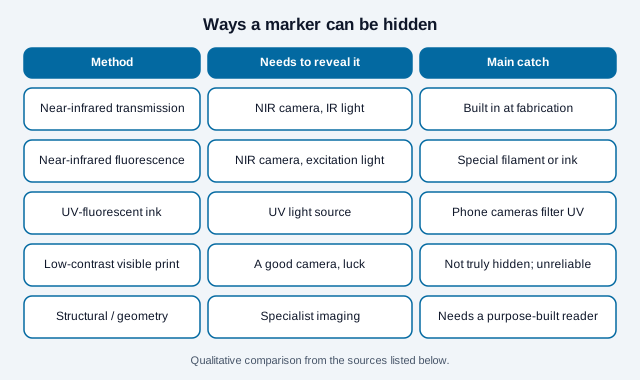
“Invisible” usually means low contrast in visible light, concealed beneath a material, or detectable mainly at a wavelength people cannot see. The marker still needs measurable contrast in the imaging channel used by its scanner.
- Near-infrared transmission: an outer material appears opaque to people but allows an infrared camera to distinguish embedded geometry.
- Near-infrared fluorescence: a material emits detectable light under suitable illumination while remaining unobtrusive in ordinary conditions.
- Ultraviolet-responsive ink: a mark becomes visible or higher contrast under UV illumination.
- Low-contrast visible printing: a pattern is subtly integrated into artwork, though it is not truly invisible and may be unreliable.
- Structural encoding: information is represented by surface or internal geometry that specialized imaging can detect.
These approaches have different equipment, durability, safety, manufacturing, and intellectual-property considerations. A result demonstrated in one research prototype should not be generalized to all inks, phones, surfaces, or QR readers.
What are InfraredTags?
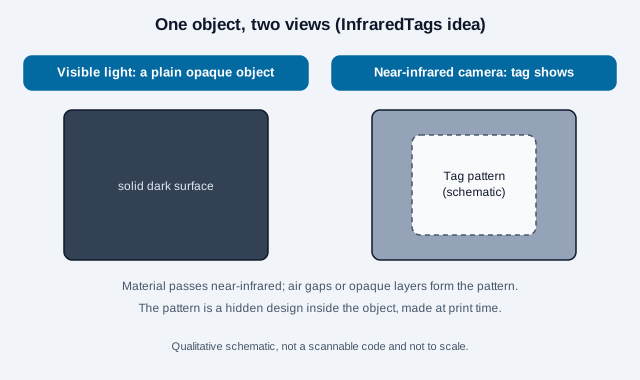
InfraredTags are a 2022 MIT research method for embedding barcodes and fiducial markers inside 3D-printed objects. The main object uses infrared-transmitting filament, while air gaps or infrared-opaque material form the hidden pattern. The object appears opaque under visible light, but a near-infrared camera can distinguish the embedded tag.
The researchers demonstrated QR codes and ArUco markers and built a compact infrared imaging module that could attach to a mobile device. In the CHI 2022 paper the body is printed in an infrared-transmitting PLA that passes roughly 45% of near-infrared light per millimeter, and the readers were a Raspberry Pi NoIR camera (with its infrared-cut filter removed) with a visible-light filter and two 940 nm LEDs for dark conditions. The authors report detection from up to 250 cm and in about 0.2 lux of near-infrared light for their best multi-material variant, and 79.03% decoding accuracy for one filter combination across 124 images taken 15 to 80 cm away. They also note results depend on the filament batch and camera sensitivity, and that curved surfaces warp the pattern. That hardware detail matters: the work did not establish that every unmodified smartphone camera can scan an embedded InfraredTag through its normal camera app.
What are BrightMarkers?
MIT CSAIL later described BrightMarker, which embeds fluorescent filament in 3D-printed objects. The material emits at a near-infrared wavelength and can be isolated with compatible imaging hardware. The UIST 2023 paper adds that the tag is placed in the digital model and exported with the print file, so it works across object colors, but it cannot be added to an object afterward, and obstructions such as hands interfere with tracking. The researchers created attachable configurations for smartphones and AR/VR headsets.
BrightMarkers illustrate the difference between a research system and a conventional printed QR Code. The marker is designed into the object before fabrication, uses special material, and relies on dedicated detection hardware. It is not a transparent ink that any default phone camera can decode.
Can an ordinary smartphone scan an invisible QR code?
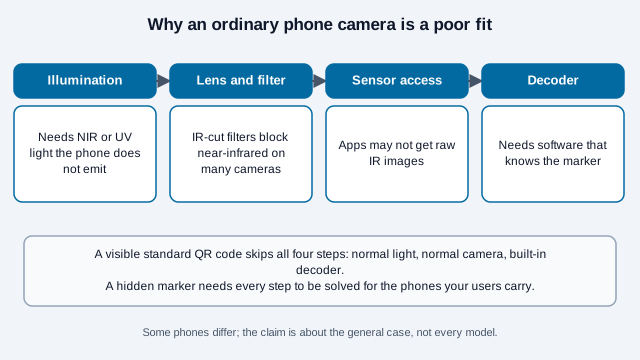
Not reliably as a general rule. Smartphone camera systems differ in infrared filtering, sensor access, illumination, lenses, and software. Face-authentication hardware may not expose raw infrared images to an ordinary application, and a visible-light camera's weak infrared sensitivity does not guarantee enough contrast for decoding.
A vendor claiming ordinary-phone compatibility should provide a precise list of supported devices and apps, test conditions, viewing distance, illumination requirements, and independent production samples. Test the complete system rather than assuming that “smartphones contain infrared sensors” proves compatibility.
What about ultraviolet ink?
UV-fluorescent inks are the older, more familiar route. A vendor explainer says phone cameras lack a UV source and filter most UV at the sensor, so UV features usually need dedicated equipment. Academic and patent work describes workarounds: Northwestern researchers reported QR codes in UV-only fluorescent inks that a smartphone could read under UV light, and a patent application describes pulsing a phone flash to read phosphorescent ink without hardware changes. These are research or claims, not tested production systems, and a UV lamp is still part of the workflow.
For brand protection, UV and infrared inks are normally one overt-and-covert layer next to a visible code, not a replacement for it. The product authentication guide explains how serialization and server checks carry the real verification.
Are hidden QR codes more secure?
Hidden does not mean secure or authentic. Concealment can make casual copying harder, but a readable marker can potentially be captured and reproduced by someone with compatible equipment. A QR payload is not encrypted merely because the pattern is difficult to see.
Authentication normally needs additional controls: unique serialization, trusted records, digital signatures, controlled issuance, anomaly detection, tamper-evident construction, or other physical security features. The verification interface must also resist imitation and explain ambiguous results honestly.
Covert marking may even reduce transparency when users do not know that an object is machine-readable. Deployments should evaluate privacy, notice, consent, surveillance risk, and local law.
Where might invisible markers be useful?
- identifying parts without changing their visible industrial design;
- tracking 3D-printed objects in augmented or virtual reality;
- connecting an object to repair or manufacturing records;
- adding machine-readable registration points for robotics or motion capture;
- supporting layered overt and covert inspection in a broader authentication system.
Each use needs an operational answer for who owns the reader, what happens when detection fails, how the mark survives wear, and whether a visible fallback is required.
Invisible code versus visible standard QR Code
| Question | Invisible or covert marker | Visible standard QR Code |
|---|---|---|
| Reader | Often specialized camera, light, app, or processing | Broad support in modern phone camera apps |
| User discoverability | Low unless instructions or another cue is provided | Recognizable visual call to action |
| Production | May require special material or fabrication | Works with ordinary print when specifications are respected |
| Security | Concealment may add a hurdle but is not proof | Visible and copyable; can link to a separate verification system |
| Best fit | Controlled research, industrial, or specialist workflow | Public information and cross-device access |
What does a failed rollout look like?
Imagine a hardware startup that molds a hidden marker into the housing of its device so support staff can pull up repair records. In the lab, a modified camera reads it every time. In the field, technicians use their own phones, the housings arrive in a different filament batch, and the marker reads in only some lighting. The team had no printed serial, so each failed read meant calling the factory. The fix was a printed serial number and a regular QR code on the device label, with the hidden marker kept as a secondary check.
The mistakes in that story are common: no visible fallback, a reader nobody owns, and testing only on one batch. The QR code not scanning guide covers the visible-code equivalents.
How to evaluate an invisible-marker vendor
- Ask whether the output conforms to standard QR Code or is a proprietary marker.
- Identify the exact camera, illumination, app, and decoder required.
- Request production samples on the intended substrate and color.
- Measure success across distance, angle, motion, wear, sunlight, and indoor lighting.
- Check whether users need a visible cue or accessibility alternative.
- Review identifier security, cloning risk, privacy, and data retention.
- Define replacement, offline, and provider-exit procedures.
- Avoid claims of unforgeability unless supported by a complete threat model and evidence.
What should you use today?
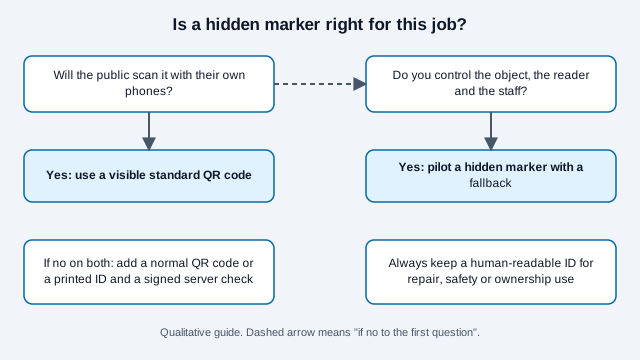
Use a visible standard QR Code when unfamiliar users must scan with their normal phones. Label its purpose, preserve the four-module quiet zone, maintain strong contrast (the color and contrast guide covers brand colors), and test the final printed material.
Consider an invisible marker only when you control the fabrication and reader environment or are running a properly designed pilot. Treat it as one system component, not a drop-in visual replacement for a universally scannable QR Code.
Keep a human-readable identifier or accessible alternative when failure would block service, safety information, repair, or ownership verification. Document the specialized reader so the marker does not become unusable when hardware, apps, staff, or suppliers change.
Open questions this page cannot settle: the two MIT systems are research prototypes, no standard exists for hidden QR-style markers, and read rates on commercial phones are not independently published. Keep any security claim modest. This is general information, not legal or security advice, and covert marking may raise privacy rules where you operate.
References
- MIT HCIE: InfraredTags research and paper
- MIT CSAIL: invisible machine-readable labels
- MIT CSAIL: BrightMarker system
- Hackaday: fluorescent filament makes object identification easier
- MIT HCIE: BrightMarker UIST 2023 paper (not opened; cited via press and search summaries)
- New Atlas: invisible QR codes in fluorescent infrared tags
- Microblink: UV fluorescent ink explainer (vendor)
- Patent 9,563,798: reading invisible insignia with an unmodified smartphone
- EurekAlert: Northwestern UV-fluorescent QR code media