An EU Digital Product Passport (DPP) is a structured digital record linked to a product through a persistent unique identifier and a physical data carrier, and a QR code is one possible carrier. Regulation (EU) 2024/1781 sets the framework, but each product group gets its own rules, dates and data fields, so there is no single QR code deadline for all goods.
This guide separates what is already fixed in EU law from what is still planned, explains why the QR symbol is only one of five layers in a passport system, walks through the operator workflow the European Commission describes, and covers the battery passport, which is the first one with a hard date. It does not give a label template, because no such template exists yet for most product groups.
Does every product sold in the EU need a QR code now?
No. The framework is broad, but concrete passport duties arise through product-specific delegated acts. The Commission's own overview says batteries are first, with mandatory passports for certain battery types from 18 February 2027, and that textiles, iron and steel, and construction products are expected to follow.
The date many articles quote, July 2026, is the deadline for the Commission to set up the central registry under Article 13 of the regulation. That is an infrastructure duty for the Commission. It is not a date by which every brand must attach a QR code to every product. The registry went live on 20 July 2026 and is still described as being in a testing phase.
Other EU laws can add earlier or different requirements, so the first job is to name the legal instrument that covers your product before you design any label.
Which dates are already fixed?
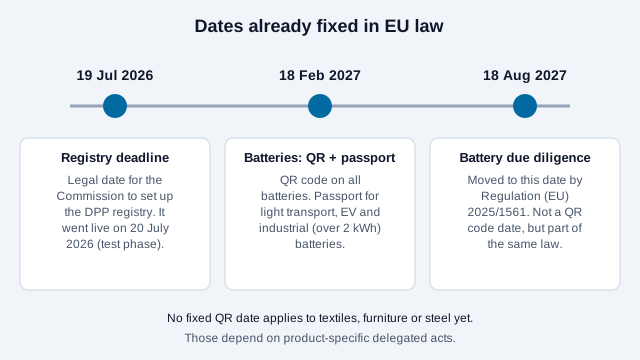
Only a few. The table separates legal dates from planning dates, because the two are easy to confuse in vendor material.
| Date | What happens | Status |
|---|---|---|
| 19 July 2026 | Deadline for the Commission to establish the DPP registry (Article 13, Regulation 2024/1781) | Fixed. The registry launched 20 July 2026 |
| 18 February 2027 | QR code on all batteries and battery passport for light means of transport, electric-vehicle and industrial batteries above 2 kWh (Regulation 2023/1542) | Fixed in the regulation |
| 18 August 2027 | Battery due-diligence duties, moved by Regulation (EU) 2025/1561 | Fixed, but not a QR date |
| Q4 2026 to 2029 | Delegated acts for steel, construction products, textiles, aluminium, tyres, furniture and mattresses | Indicative Commission planning only |
When do other product groups get their rules?
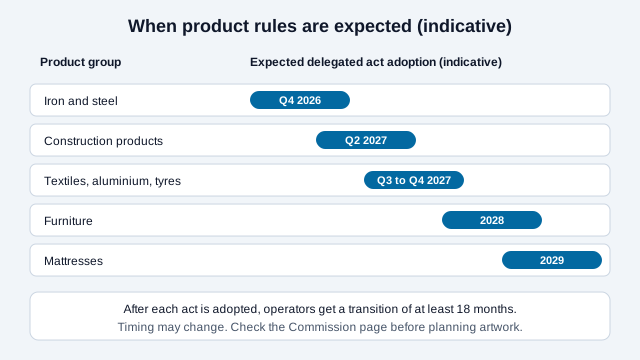
The Commission publishes an indicative timeline and warns that it is subject to change. It lists a delegated act for iron and steel in Q4 2026, construction products in Q2 2027, textiles, aluminium and tyres in Q3 to Q4 2027, furniture in 2028 and mattresses in 2029. Its textile page lists the planned adoption of the textiles delegated act as Q4 2027 and states that the passport will be reachable online at points of sale and through a data carrier on the product, such as a QR code.
The Commission also says economic operators get a transition period of at least 18 months after each delegated act is adopted. For a textile brand that points to a working deadline well after 2027, but the exact application date will come from the act itself.
What is the difference between a QR code and the passport?
| Layer | Role |
|---|---|
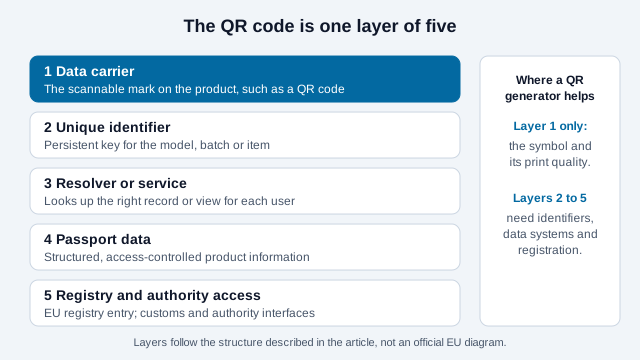
| Data carrier | The scannable symbol or other technology physically associated with the product |
| Unique identifier | The persistent key connecting the product, batch or model to its record |
| Resolver or service | The infrastructure that finds the right record or view for each user |
| Passport data | The structured information, evidence and access-controlled fields |
| Registry and authority access | EU infrastructure and interfaces for oversight and customs |
Changing artwork addresses only the first row. A robust implementation governs all five, and a generic QR generator supplies the symbol and nothing else.
What information can a passport contain?
Annex III of Regulation (EU) 2024/1781 lists possible passport elements, and the applicable delegated act decides the real fields and who may see them. Possible elements include a persistent unique product identifier, commodity codes and compliance documentation, manufacturer, importer and facility identifiers, instructions and warnings, data on materials, durability, repair, recycling or environmental performance, and references to conformity certificates.
Not all passport data is public. The framework anticipates different access for customers, economic operators, repairers, recyclers, authorities and customs. Customer personal data must not be stored without explicit consent consistent with EU data-protection rules, so a public product page should never be the place for confidential or personal fields.
What do the new EU standards say about the carrier?
Six European standards for the passport system were published in 2026: EN 18216 (data exchange), EN 18219 (unique identifiers), EN 18220 (data carriers), EN 18221 (storage and persistence), EN 18222 (APIs and lifecycle management) and EN 18223 (system interoperability). Industry sources report that CEN and CENELEC published them in late May 2026 and that Commission Implementing Decision (EU) 2026/1736 of 14 July 2026 lists them under the regulation.
Secondary summaries say EN 18219 covers identifiers for products, economic operators and facilities at model, batch or item level, and that EN 18220 covers optical 2D codes, RFID and NFC, including encoding, reading quality, error correction, durability and placement. The standards themselves were not on sale when this was written, so the technical parameters, such as which QR error correction level is acceptable, are unverified here. Read the standards or ask a standards body before you fix a print specification.
What does an operator actually do?
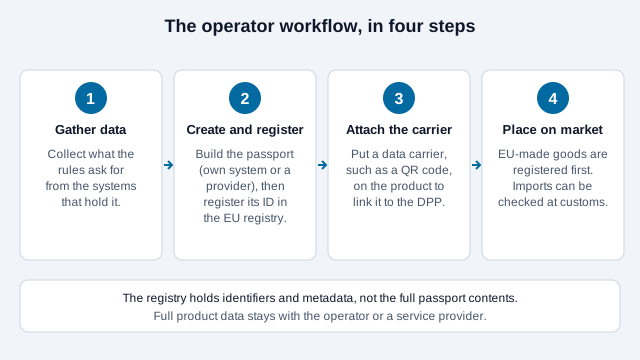
The Commission describes four steps for businesses: gather the product information required under the applicable EU legislation, create the passport and register it in the registry (the full data can sit with the operator or a service provider), attach a data carrier such as a QR code that links the product to its passport, and make sure EU-made products are registered before they are placed on the market. Imported products can be checked at customs. Once a product is registered, the registry generates a unique registration identifier.
The registry holds identifiers and metadata. It does not hold the whole passport, which is why the data and the service behind the QR code remain your responsibility.
How does the EU battery passport differ?
The Batteries Regulation is separate, sector-specific law with explicit dates and categories. From 18 February 2027 all batteries must bear the prescribed QR code. For light means of transport batteries, industrial batteries above 2 kWh and electric-vehicle batteries, that code gives access to the battery passport. For other batteries the code leads to other defined information.
This is why "DPP QR code" is not one universal template. Commentary from industry sources reports that the rules on who can read the battery passport were still draft implementing work in 2026, that the passport date has no postponement clause, and that some content, such as carbon footprint and recycled content, is not required on day one because its methodology acts are not adopted. Battery due-diligence duties were separately moved to 18 August 2027 by Regulation (EU) 2025/1561. Battery operators should work from Regulation (EU) 2023/1542 and the acts under it, not from the general ecodesign framework.
How should a small brand prepare now?
Imagine a small sock brand selling to shops in several EU countries. It has no delegated act for textiles yet, so it cannot print a compliant production label. It can still do the groundwork:
- Check whether your product group has a dated rule. Batteries do. Textiles, footwear and furniture have planning dates only.
- Get globally unique identifiers. GS1 identifiers can support an interoperable setup, but a GS1 license is not a universal DPP requirement. A GTIN is also relevant to GS1 Sunrise 2027.
- Inventory the data you hold on materials, suppliers, care, repair and compliance documents, and note which system holds each item.
- Name an owner for accuracy, updates, access rights and retention, rather than leaving it with packaging or marketing alone.
- Prototype the carrier as a GS1 Digital Link QR code pointing to a product page. The work carries over whether the final rule requires model, batch or item identification.
- Choose systems whose records can be exported if you change provider.
- Hold production labels until the applicable act defines carrier, placement and data fields.
What should the physical QR production checklist include?
Once the rule and identifier scheme are settled, the label still needs production controls:
- encode the approved persistent identifier or resolver syntax exactly;
- keep the quiet zone and strong contrast, and avoid artwork over functional modules;
- test the real substrate, curvature, finish, wear and scanning distance with the scannability tester or a print proof, and see the print size guide;
- check decoded identifiers against authoritative records;
- maintain redirects, certificates, hosting and backups for the required period, and see why QR codes can stop working;
- document version control and a replacement procedure.
For how packaging rules intersect with this, see the packaging guide. For retail checkout, see QR codes in retail.
What mistakes cause trouble?
Imagine the same sock brand reads a blog post saying all EU goods need a passport by July 2026. It prints 50,000 labels with a short marketing URL on a free generator account and a plain page that says "Compliant". Months later the delegated act asks for batch-level identifiers on a different carrier standard, the free account lapses, and the QR codes open a dead page. The mistakes in that story are the common ones:
- Claiming that every EU product needs a passport by July 2026.
- Printing production labels before the carrier and placement rules exist.
- Using one shared QR code when item or batch identification is required.
- Putting confidential or personal data on an unrestricted public page.
- Relying on a short-lived domain, redirect account or closed provider format.
- Assuming a green "compliant" page proves the data behind it is accurate.
What is still unsettled?
Several things no checklist can settle for you. The final carrier, placement and identifier level for textiles and most other groups will come from delegated acts that have not been adopted. The Commission's dates are indicative, and the registry is in a testing phase. The full text of the new EN standards was not available to check here, and several battery details come from industry commentary, so verify them against the Official Journal. Your own product may also fall under another EU law with earlier dates.
This article is a technical and editorial overview, not legal advice. Confirm obligations with the official regulation, applicable delegated acts, sector rules, standards and a qualified adviser for your product and market.
References
- EUR-Lex: Regulation (EU) 2024/1781 (Ecodesign for Sustainable Products Regulation)
- European Commission: Digital Product Passport
- European Commission: Digital Product Passport registry now live (20 July 2026)
- European Commission: Digital Product Passport for textiles and apparel
- EUR-Lex: Commission Implementing Decision (EU) 2026/1736 on harmonised standards for digital product passports
- WIoT Group: CEN and CENELEC publish six EU DPP standards (secondary source)
- EUR-Lex: Regulation (EU) 2023/1542 on batteries
- EUR-Lex: Regulation (EU) 2025/1561 (battery due-diligence deferral)
- Arianee: EU Batteries Regulation timeline (secondary source)