A parking QR code lets a driver pay, extend a session, claim a validation or start an EV charge from a phone. Give each zone its own link on the operator's own domain, print that web address next to the code, protect the sign against sticker overlays, and keep a way to pay that does not need a QR code.
Operators put these codes on curbside meters, garage columns, tickets and lot signs, and drivers scan instead of feeding a pay station. That can cut the hardware to maintain, but it also puts your payment page on a surface anyone can cover with a sticker, so parking is one of the places where the printed code needs the most care. This guide covers how the systems work, how to build a code and a sign that resist tampering, how payments reach enforcement, EV charging rules in the EU, and what to do when drivers cannot scan.
How does a parking QR code system work?
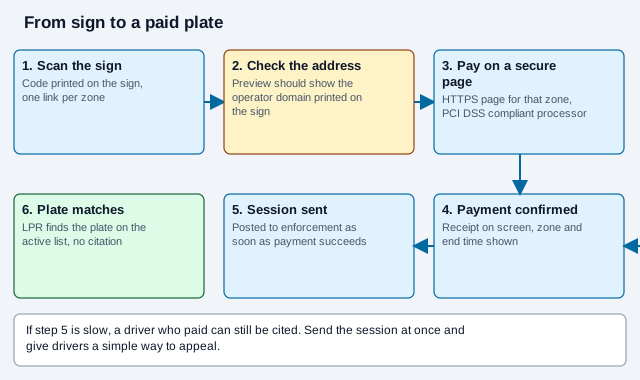
Each code holds a web link for a location, such as a zone, a numbered stall or a garage. The driver scans it, lands on a secure payment page with the zone or space already filled in, and pays in the browser or with Apple Pay or Google Pay. No token dispenser or card reader is needed on site.
| Setup | What the code identifies | What the driver does |
|---|---|---|
| Curbside zone | A street block or zone ID | Scan, choose a duration, pay, and enter a license plate |
| Individual stall | A numbered space | Scan, pay, and the space is already selected |
| Garage ticket validation | A ticket or entry record | A retailer scans the ticket to apply a discount, then the driver pays or exits |
| EV charging point | A charger and its session | Scan, accept the price, plug in and monitor the charge |
| Permit tag | A permit record | Enforcement scans the windshield tag to check that the permit is active |
How do you create a secure parking payment code?
- Give every zone or stall its own link, for example
https://park.cityname.gov/pay?zone=4081, rather than one generic payment portal. A specific link also lets you find which sign a scan came from. - Serve the page over HTTPS on the operating agency's own domain, and use a payment processor that is compliant with the PCI DSS standard. A padlock only shows that the connection is encrypted, so it proves little about who owns the page. Tell drivers to compare the domain in the phone's camera preview with the address printed on the sign.
- Paste the link into the free QR code generator and choose a high error correction level, which gives margin for a sign that will scuff and get dirty. A higher level adds modules, so keep the link short and print the code larger.
- Export an SVG for the sign maker so the pattern stays sharp at any size. The SVG guide explains why.
- Print the agency name and the exact web address beneath the code, so drivers can compare what they scanned against what the sign says.
- Protect the printed face with a matte, UV-resistant overlaminate to reduce glare and fading.
A static code never expires and costs nothing to keep, which suits a sign whose link will not change. If you need to reroute a zone, pause a code or see scan counts per sign, a dynamic code can help, but it adds a redirect service that you must secure and keep paid for. Document who owns that domain and account.
What is the sticker-overlay scam, and how long has it been going on?
The main risk at a parking meter is the sticker on top of the code. A scammer prints their own code, pastes it over the real one, and sends drivers to a fake payment page that collects card details. The warnings go back several years and have grown louder.
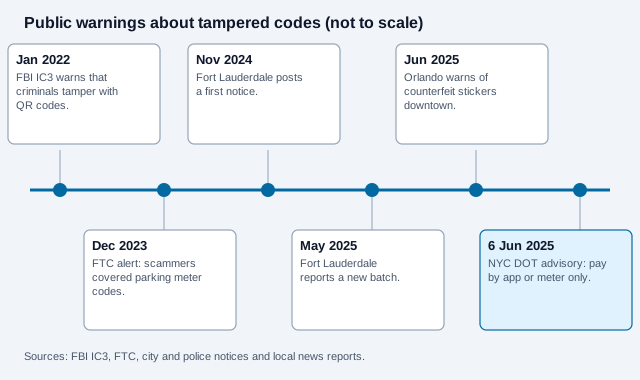
- The FBI's Internet Crime Complaint Center warned in January 2022 that criminals tamper with physical and digital QR codes to redirect payments and steal credentials.
- The FTC's December 2023 consumer alert says scammers have covered QR codes on parking meters with their own.
- Fort Lauderdale posted a notice in November 2024 and reported a new batch in May 2025, advising people to use only codes printed directly on official signs.
- Local reports in June 2025 described about 200 counterfeit stickers on downtown Orlando meters.
- On June 6, 2025, the New York City DOT issued an advisory after finding at least one fake sticker on a ParkNYC meter, telling drivers to pay only through the official app or a meter and to report the sticker.
Operators can build defenses into the sign itself.
| Control | How it helps |
|---|---|
| Print directly onto the sign, with no separate sticker | A sticker of any kind then stands out as foreign |
| A raised or recessed frame around the code | A sticker will not sit flush, so its edges lift or bubble |
| The official web address printed in clear text | Drivers can check that the camera preview matches before they tap |
| Regular inspections by enforcement staff | Tampered codes get removed before many drivers are affected |
| Tamper-evident materials | An attempt to peel or replace the sign leaves visible damage |
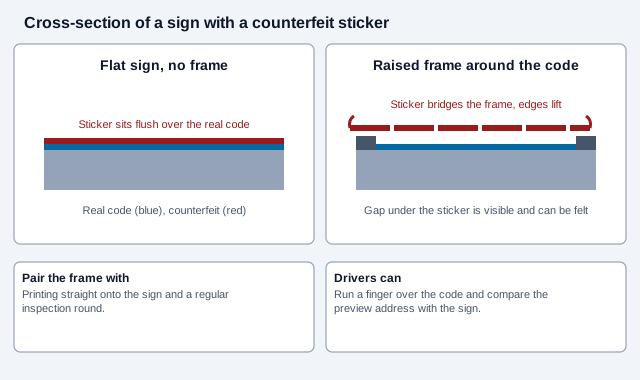
Drivers can help themselves too. Run a finger over the code before scanning, check the domain in the preview, and go to the operator's own website or app if anything looks wrong. The FBI also advises not to download apps from a QR code and to use the built-in camera instead of a third-party scanner. Our guide to checking QR code safety and the quishing guide cover what to look for.
What does a good parking sign look like?
A sign works when a driver can understand it at a glance, in glare, with one hand on a car door. The anatomy below combines the controls above in one layout.
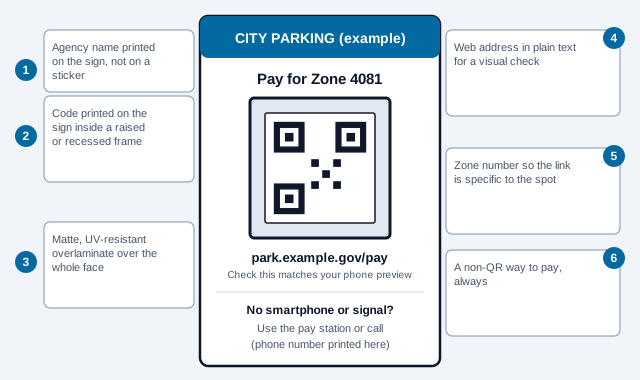
Signs have to survive sun, road salt, rain and temperature swings while keeping strong dark-on-light contrast. Cheap paper or vinyl fades and stops scanning reliably. Ask your sign supplier for the rated lifespan of the exact product in your climate, and test a production sample on several phones before ordering a batch.
How big should the code be?
Size depends on how far away people scan from. A common rule of thumb is a code about one tenth as wide as the scanning distance. That is a widely used guideline, not part of the ISO spec. A driver scanning from a car window at about 60 in (150 cm) needs a much larger code than a pedestrian scanning at 12 in (30 cm), and a garage column needs its own test. Confirm the size with a printed test in the real position, and see our QR code print size guide.
- Choose matte finishes. Glossy laminates reflect headlights and sun into the camera.
- Keep the frame, bolts and any text at least four modules away from the code's edge, or the scanner may not find the corner squares.
- For printed tickets that sit on a dashboard, ask the supplier about heat resistance, since ordinary thermal paper can darken in a hot car.
How should payments reach enforcement?
Enforcement often uses license plate recognition (LPR) cameras that check plates against a list of active sessions. If a driver pays through the QR page but the payment does not reach the enforcement database quickly, that driver can receive a citation despite having paid. Send the session to enforcement as soon as payment succeeds, show a confirmation with the zone and end time on screen, and give drivers a simple way to appeal a citation they received despite paying.
What rules apply to EV charging payments?
In the EU, the Alternative Fuels Infrastructure Regulation (AFIR) sets ad hoc payment rules for public chargers. Industry coverage reports that new public DC chargers of 50 kW or more must offer a card reader or contactless payment, with the requirement extended to existing chargers of that size from 2027. Below 50 kW, other secure methods are allowed, and the European Commission's Q&A reportedly says a static QR code can comply "as long as it is readable and the security of the payment transaction is ensured." Some commentators dispute how far that goes. The sources here are trade press, not the regulation text, so check Regulation (EU) 2023/1804 and your national rules before you design a charger sign. Outside the EU, the rules differ.
What if drivers cannot scan or load the page?
- Glare from sunlight or headlights: switch to a matte finish and reposition the sign if you can.
- Underground levels with weak mobile reception: payment pages may not load. Provide a fallback payment method such as a pay station, or place the sign where signal is better. A Wi-Fi QR code for guest access near the signs is another option if the garage can provide it.
- An older driver or a driver without a smartphone: keep a pay station or a phone number, so the QR code is never the only option.
- A low battery or a cracked camera: the printed web address lets the driver type the address instead.
How does a parking code fail on site?
Think of a small town that replaces its meters with signs carrying one sticker-style code per block. The stickers come from a print shop, are stuck on by hand, and use a single payment link for all zones. A fake sticker goes up on the busiest block within a week. Drivers see two identical-looking codes on the sign, one slightly raised at the edge, and cannot tell which is real. Some pay on the fake page. The town learns of it only when complaints arrive.
A fix would print the code and the web address directly on the sign, add a recessed frame, give every block its own link, and schedule a weekly inspection with a photo log. It would also keep the pay station on the busiest blocks and publish a notice that says "Pay only through the address printed on the sign or our app."
What is a rollout checklist for a parking operator?
- List every sign, zone and stall, and assign one link each.
- Confirm the payment page uses HTTPS on your domain and a PCI DSS compliant processor.
- Build the codes at a high error correction level and export SVG.
- Print directly onto the sign, with a frame and a matte UV-resistant overlaminate.
- Print the agency name, zone number and web address in clear text.
- Test a production sign on several phones in sun, shade and at night, from where drivers stand.
- Connect payment confirmation to the enforcement list and test the delay.
- Keep a pay station or phone option for drivers who cannot scan.
- Inspect signs on a schedule and write down who removes a counterfeit sticker and who reports it.
Which parking rules depend on your operator?
Several points depend on your location and contract. Payment, privacy and consumer rules differ by country and state, and an operator also has duties to people who cannot use a smartphone. The best inspection interval depends on how often your signs are targeted, and the number of counterfeit stickers reported in local news is not a measure of how common the problem is overall. The EU rules on EV charging are described here from trade press, and static versus dynamic QR code interpretations may still change.
This guide is general information, not legal or financial advice. Check payment-security, privacy and parking rules with your local authority and a qualified adviser.
References
- ISO/IEC 18004:2024, QR code bar code symbology specification
- FTC: scammers hide harmful links in QR codes (December 2023)
- FBI IC3: cybercriminals tampering with QR codes to steal victim funds (January 2022)
- PCI Security Standards Council: PCI DSS
- NYC DOT: parking meter scam advisory (June 2025)
- WSVN: Fort Lauderdale police warn drivers of fake QR codes at parking meters
- ClickOrlando: warning over fake QR codes on downtown Orlando parking meters (June 2025)
- electrive: AFIR, static QR codes remain a permissible payment option at charging stations