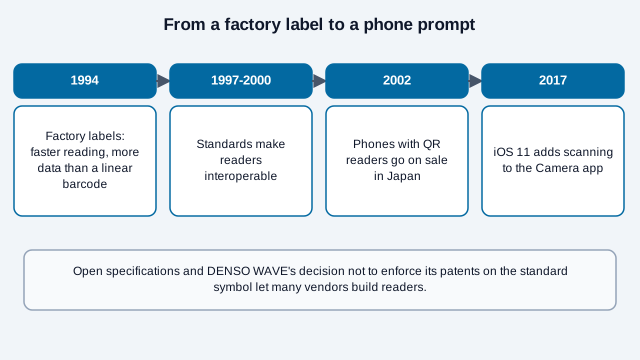
The QR Code was developed in 1994 by a small DENSO team led by Masahiro Hara. The project began in Japan's automotive manufacturing sector, where one-dimensional barcodes could not hold enough information and repeated scanning slowed production. “QR” means “Quick Response,” reflecting the team's emphasis on fast reading.
Its later success came from more than capacity. The finder patterns made the symbol quick to locate, error correction helped it tolerate damage, public specifications encouraged implementation, and camera phones eventually put compatible readers in consumers' hands. For how the pattern itself stores data, read how QR codes work.
Who invented the QR Code?
DENSO WAVE credits Masahiro Hara and a two-person development team with creating QR Code. At the time, DENSO WAVE was a division of DENSO CORPORATION and developed barcode readers for manufacturing.
DENSO WAVE's history page says common barcodes held only about 20 alphanumeric characters, and that users asked for a code that could also represent Kanji and Kana. The team's stated hardest problem was making the code read as fast as possible. After about a year and a half of trial and error, DENSO WAVE reports, they had a code that held about 7,000 numerals, could encode Kanji, and read more than ten times faster than other codes of the time.
Hara has described the idea arriving while he arranged black and white stones on a Go board at lunch, a quote reported by Nippon.com and repeated in press coverage. That anecdote comes from his own later recollection and is not in the DENSO WAVE page, so treat it as a colorful account, not a documented design record.
Why does a QR Code have three large squares?
The three finder patterns help a scanner identify the symbol's location and orientation rapidly. DENSO's history explains that the team searched printed materials for patterns least likely to occur elsewhere. The distinctive black-and-white ratio around the square finder pattern reduced false detections. DENSO WAVE gives that ratio as 1:1:3:1:1 (dark, light, dark, light, dark), which a reader can pick out along a line at any angle.
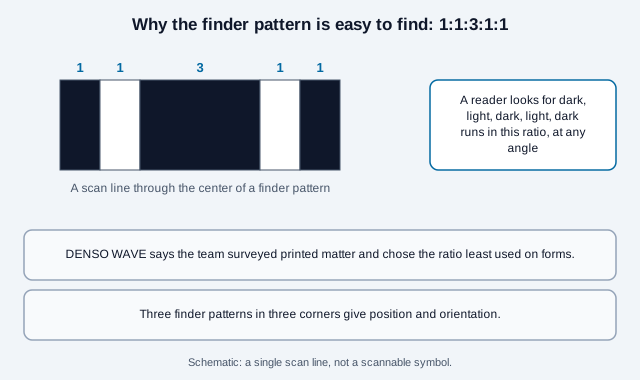
Because the patterns occupy three corners, a reader can determine the symbol's position and orientation. Other functional elements support timing, alignment, format information, and decoding. These features distinguish QR Code from a generic square mosaic.
What problem did QR Code originally solve?
QR Code first improved production control and traceability in the automotive industry. Traditional barcodes encode data along one dimension and often required workers to scan several labels. A two-dimensional carrier could hold more information in a compact area.
After its 1994 release, the automotive sector adopted QR Code for electronic Kanban and processes spanning production, shipping, and transaction records. Its use then expanded into other industries that needed product and process traceability.
Why was QR Code available for widespread use?
DENSO WAVE retained patent rights but states that it chose not to exercise those rights for standardized QR Codes. It also made the specifications publicly available. This allowed manufacturers and software developers to implement the technology without a per-code licensing barrier from the inventor.
That decision did not mean every product called a “QR code” or every related service became free of all intellectual-property and service terms. It meant the standardized symbol could become a broadly implemented public code.
When did QR Code become a standard?
| Year | Milestone |
|---|---|
| 1994 | DENSO announced QR Code. |
| 1997 | It became an AIM standard for automatic identification. |
| 1998 | JEIDA standard (JEIDA-55), per DENSO WAVE's list. |
| 1999 | It became a Japanese Industrial Standard (JIS X 0510). |
| 2000 | It became an ISO international standard. |
| 2002 | Consumer use expanded in Japan as phones with QR readers reached the market. |
| 2004 | Micro QR Code was added to the Japanese Industrial Standard. |
| 2008 | iQR Code, a variant, was introduced (DENSO WAVE). |
| 2011 | GS1 approved QR Code as a standard for mobile phones. |
| 2014 | FrameQR, a variant that allows illustrations and photos in the design (DENSO WAVE). |
| 2017 | iOS 11 added QR scanning to the iPhone Camera app (Apple and press coverage). |
The ISO/IEC 18004 standard has gone through at least four editions: 2000, 2006, 2015 and 2024 (Edition 4, published August 2024 per ISO). The search listings used for this page do not describe what changed between editions, so check the standard itself for details.
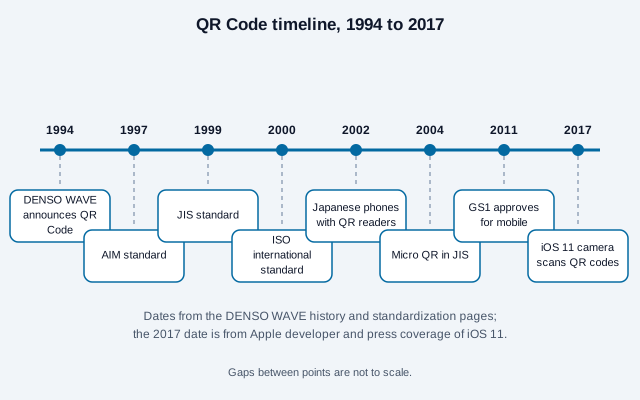
The current standardized family is governed through specifications such as ISO/IEC 18004. A conformance-sensitive deployment should consult the applicable standard and industry profile rather than relying only on visual similarity.
How did QR Codes move from factories to phones?
Camera phones converted QR Code from an industrial data carrier into a consumer interface. DENSO identifies 2002 as the point when phones with QR-reading features helped popularize consumer uses in Japan, including website access and coupons.
Apple's iOS 11 added automatic QR detection to the Camera and Safari in 2017, found by developers in the first beta in June 2017 and not announced in the keynote. Android makers added their own scanning routes at different times, which this page does not date. Later smartphones, faster cameras, better decoding software, and built-in scanning reduced the need for a dedicated reader. The symbol became a convenient bridge from physical media to web pages, tickets, contact details, payments, authentication flows, and app actions.
The COVID-19 pandemic did not invent consumer QR use, but it accelerated contactless applications such as menus and check-in systems in many markets. By then the enabling standards and mobile hardware had existed for years.
Was QR Code the first two-dimensional barcode?
No. Two-dimensional symbologies existed before 1994. QR Code's historical importance comes from the combination of fast orientation, useful capacity, damage tolerance, open implementation policy, industrial adoption, and later phone support. It should not be described as the invention of all 2D barcodes.
Linear barcodes also did not become obsolete. They remain efficient for many established retail and logistics workflows. Organizations choose a carrier based on standards, required data, printing space, scanner infrastructure, and the business process, not simply because one format is newer.
How has QR Code evolved?
DENSO and standards organizations developed variants for specialized needs. Micro QR Code reduces the finder-pattern overhead for small spaces but offers lower capacity and is not as universally supported by consumer camera apps. Other variants include rectangular and security-focused forms.
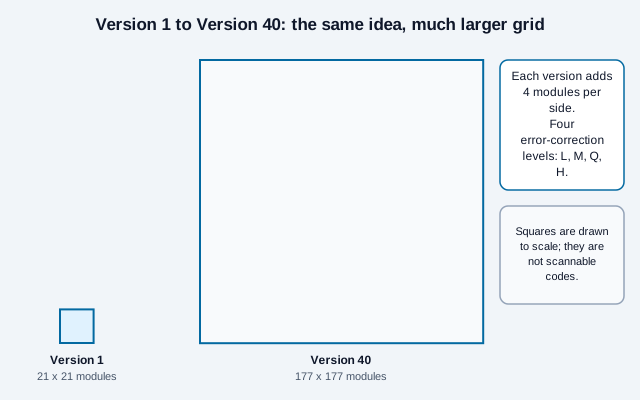
For general public scanning, standard Model 2 QR Code remains the safest compatibility choice. It supports Versions 1 through 40, from 21 by 21 to 177 by 177 modules (each version adds four modules per side), and includes four error-correction levels. See error correction levels and the Micro QR guide for the practical choices.
What made QR Code endure?
- Fast detection: finder patterns help readers locate and orient the symbol.
- Useful capacity: two-dimensional encoding stores more data than a typical linear barcode.
- Damage tolerance: Reed–Solomon error correction can restore some corrupted codewords.
- Standardization: published standards made implementations interoperable.
- Low-friction access: compatible cameras made scanning available to ordinary users.
- Flexible payloads: the symbol can carry text or structured data interpreted by software.
A QR Code itself is only a data carrier. Its longevity does not guarantee that a linked page will remain online, that a destination is trustworthy, or that a particular workflow is accessible. Good modern use still requires a stable destination, clear call to action, safe design, and real-device testing.
Why the original history still matters to users
The manufacturing origin explains why QR Code prioritizes quick machine detection and resilience rather than visual decoration. The standardization history explains why unrelated devices can decode the same symbol. The transition to phones explains why a technical identifier became a familiar call to action.
These lessons remain practical: preserve functional patterns, use a conforming encoder, avoid unnecessary data density, and test the whole user journey. A creative design succeeds only when the standardized symbol remains readable and its destination remains useful.
Which QR history claims should you double-check?
Picture a school newsletter that says "QR codes were invented in 1994 by a Japanese car company to track parts, and they went viral during COVID because phones finally got scanners." Several things are tangled. DENSO WAVE announced the code in 1994 and has said that Japanese phones with readers appeared in 2002. iPhone scanning arrived in the Camera app in 2017, years before the pandemic. The pandemic raised use in menus and check-in, but it did not introduce the scanner. For a plain-language version, read what a QR code is, and see QR code statistics before quoting any adoption figure.
- "Hara invented all 2D barcodes": not true; earlier 2D symbologies existed.
- "QR codes are free, so nothing needs a license": the standardized symbol is not enforced against, but services built around it have their own terms.
- "They expire": a code does not expire; a hosted destination can. See do QR codes expire.
What this page cannot settle
Open questions this page cannot settle: the exact count of 1994 installations, how many other early 2D codes influenced the design, and when each Android maker added native scanning. Treat anecdotes, including the Go board story, as reported accounts. Linear barcodes remain central to retail and logistics; see QR codes vs barcodes in logistics, and how to scan a QR code for the modern user view. This is general historical information.
References
- DENSO WAVE: history of QR Code
- DENSO WAVE: QR Code standardization
- DENSO WAVE: versions and information capacity
- The Star: QuickCheck on the QR code and the board game story
- ISO: ISO/IEC 18004:2024
- MacRumors: iPhone can scan QR codes in the Camera app on iOS 11
- Apple Developer: QR code recognition in iOS 11
- North Coast Journal: QR code inventor account quoting Nippon.com