A Micro QR Code is a compact member of the QR Code family designed for very small marking areas. It uses one position-detection pattern instead of the three used by standard QR Code and needs a two-module quiet zone rather than four modules. The smaller footprint comes with sharply lower capacity: at most 35 numeric digits.
This guide compares Micro QR with standard QR, lists what each of the four versions can store, shows how to pick between Micro QR, rMQR, Data Matrix and standard QR, and sets out how to validate a tiny mark before it goes into production. Micro QR is useful in controlled industrial systems where the encoder, printer, verifier and scanner all support it. It is usually the wrong choice for menus, posters or business cards, because ordinary phone-camera support cannot be assumed.
How is Micro QR different from standard QR Code?
| Feature | Micro QR Code | Standard QR Code Model 2 |
|---|---|---|
| Finder patterns | One | Three |
| Versions | M1 through M4 | 1 through 40 |
| Grid size | 11×11 to 17×17 modules | 21×21 to 177×177 modules |
| Required quiet zone | Two modules | Four modules |
| Maximum numeric capacity | 35 digits | 7,089 digits |
| Public phone use | Support must be verified | Broadly supported by modern camera apps |
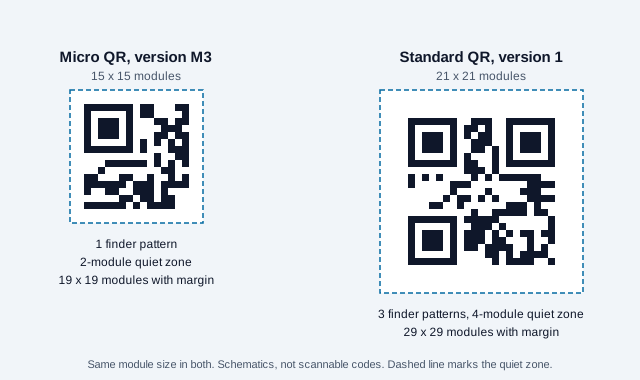
With one finder pattern in a corner, the reader has less to locate and the symbol has fewer fixed modules to spend. Technical descriptions of the format also note that the timing pattern runs along just the two edges next to that finder, rather than between three of them as in standard QR. The module count is not a physical measurement, though. Final dimensions depend on the size at which each module can be reproduced and resolved by the selected printing and scanning equipment.
DENSO WAVE, the format's developer, states that Micro QR was approved in November 2004 as JIS X 0510, and that the company has waived its patent rights and published the specification. Vendor documentation also places Micro QR inside ISO/IEC 18004, although those sources cite different editions (2015 and 2024), so check which edition your specification requires.
What can each Micro QR version store?
Micro QR has four versions, and not every version supports every data mode or correction level. M1 holds numbers only and has error detection but no correction. M2 adds alphanumeric characters. M3 and M4 add bytes and Kanji. DENSO WAVE publishes the following maximums.
| Version | Modules | Level | Numeric | Alphanumeric | Bytes | Kanji |
|---|---|---|---|---|---|---|
| M1 | 11×11 | None | 5 | n/a | n/a | n/a |
| M2 | 13×13 | L | 10 | 6 | n/a | n/a |
| M2 | 13×13 | M | 8 | 5 | n/a | n/a |
| M3 | 15×15 | L | 23 | 14 | 9 | 6 |
| M3 | 15×15 | M | 18 | 11 | 7 | 4 |
| M4 | 17×17 | L | 35 | 21 | 15 | 9 |
| M4 | 17×17 | M | 30 | 18 | 13 | 8 |
| M4 | 17×17 | Q | 21 | 13 | 9 | 5 |
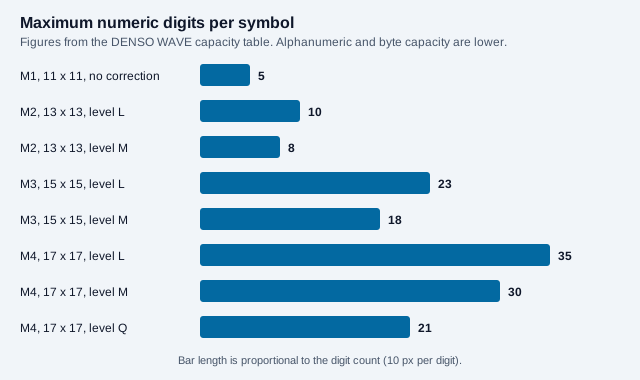
Micro QR does not offer standard QR Code's Level H. DENSO also points out that the largest Micro QR symbol holds less than a Version 1 standard QR Code, so there is no capacity to spare. Mixed characters can switch encoding modes and reduce capacity, which is why the visible character count alone is unreliable. For standard QR limits by mode and level, see the QR capacity guide, and for how the correction levels trade capacity for resilience, the error correction levels guide.
How much smaller is a Micro QR mark, really?
Take a hypothetical 12-digit serial number. M2 at Level L tops out at 10 digits, so it does not fit. M3 at Level M holds 18 digits, so it fits in a 15×15 grid. Add the two-module quiet zone on each side and the footprint is 19×19 modules, or 361 module cells.
A standard Version 1 symbol is 21×21 modules and needs a four-module quiet zone, so it is 29×29 modules, or 841 cells. On that arithmetic the Micro QR mark covers less than half the area at the same module size. The saving is real but it only holds if the marking process can produce modules at the same size in both cases, which is the subject of the next section.
Does a smaller grid guarantee a smaller usable mark?
No. A Micro QR symbol uses fewer modules, but the minimum reliable module size still depends on the marking process, optics, working distance, motion and surface. A poorly formed 17×17 symbol can be less dependable than a larger standard QR Code with clean modules.
Include the quiet zone when comparing total footprint. Also account for surrounding text, registration tolerances, label cutting and any protective coating. If a scanner needs a dedicated close-up setup, the operational cost may outweigh the saved area. DENSO WAVE's own troubleshooting notes warn that resizing a code with an image tool can distort every module, and that text or pictures placed within the margin make a symbol hard or impossible to read. Both warnings apply with more force to a symbol only a few millimeters wide. Our print size guide covers module size for standard codes.
When should you use Micro QR?
Use it when the marking area is constrained, the payload is tiny, and every component in the workflow explicitly supports the symbology. Possible controlled applications include component identifiers, compact production labels, laboratory samples and internal traceability. The deciding factor is not simply whether a normal QR Code looks too large. Confirm:
- the governing industry or customer specification permits Micro QR;
- the exact payload fits the chosen version and correction level;
- the printer can reproduce the required module size and quiet zone;
- fixed scanners or machine-vision software are configured for Micro QR;
- verification includes the actual material, finish, speed and viewing angle;
- operators can distinguish this carrier from standard QR and other 2D symbols.
Imagine a small electronics shop that wants to etch a short batch number onto circuit-board corners. The board has a free patch about the size of a grain of rice, and a standard QR code with its margin will not fit. Micro QR may suit the job, but only after the shop confirms that its marking laser can form clean modules at that size and that the inspection camera is set to decode Micro QR. A handheld phone in the repair bench drawer is a separate question, answered in the next section.
Can an iPhone or Android phone scan Micro QR?
Do not assume native phone-camera support. A phone may have enough camera resolution yet lack a decoder that recognizes Micro QR. Support can differ by operating-system version, device maker, camera app and third-party scanner. Google's ML Kit barcode documentation, for example, lists Aztec, Data Matrix, PDF417 and QR Code among its 2D formats and names no separate Micro QR format, while at least one commercial scanning SDK advertises Micro QR as a feature. That points to Micro QR being an add-on capability, not a given. The sources consulted for this guide document no Micro QR support in the built-in camera apps of either platform, so test instead of assuming.
If the audience is the general public, standard QR Code is the safer default. If a specialized mobile app controls the workflow, test the exact decoder library and supported devices. A successful scan in one third-party app does not prove that built-in camera apps will behave the same way. For the ordinary phone workflow, see how to scan a QR code.
Micro QR, Data Matrix, rMQR or standard QR?
These formats are not interchangeable merely because they fit small spaces.
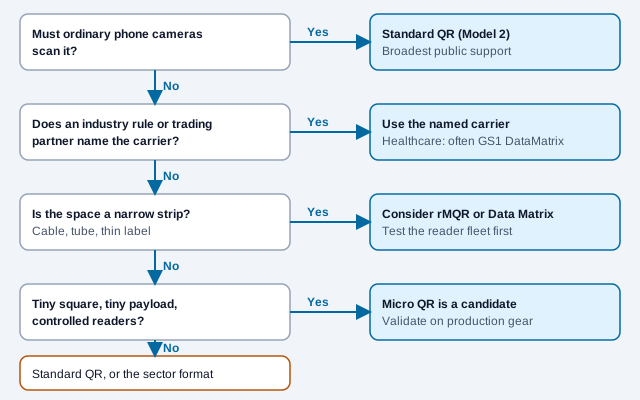
- Micro QR is compact and square, with very limited capacity.
- Data Matrix is widely used for small-item and regulated marking in established industry profiles.
- rMQR is a rectangular QR-family symbol for narrow spaces. DENSO WAVE lists sizes from 7×43 to 17×139 modules and capacity of up to roughly 361 numeric characters, which is more than Micro QR in some layouts. It received ISO approval in May 2022, published as ISO/IEC 23941.
- Standard QR Code offers the broadest public phone compatibility when enough area is available.
Choose according to the governing application standard and installed scanner base, not visual preference. Our QR code explainer places these variants in the wider family, and QR codes versus barcodes in logistics covers the older carriers.
Is Micro QR used for pharmaceutical traceability?
Small healthcare packages and components create legitimate marking challenges, but Micro QR should not be presented as a universal pharmaceutical requirement. Regulated product identification often specifies a particular carrier, data structure and verification process. For example, GS1 healthcare implementations commonly use GS1 DataMatrix, and a GS1 US summary describes the US Drug Supply Chain Security Act as calling for a 2D barcode such as GS1 DataMatrix on individual saleable units. Industry sources describe that data matrix as the machine-readable carrier expected within the product identifier.
The search for this guide did not find a rule that says Micro QR is allowed or forbidden for drugs, so treat that as unverified. Before selecting any code for a regulated item, consult the applicable jurisdiction, product category, standards body, trading partner and validation requirements. A technically scannable mark can still be noncompliant with the required system. For retail and supply-chain identifiers that do use QR, see the GS1 Digital Link guide.
What information belongs in a tiny code?
Prefer a short identifier whose meaning is resolved by the controlled system. Trying to embed descriptions, long URLs or multiple business fields can exceed Micro QR capacity quickly, since the biggest symbol holds 15 bytes at Level L. The identifier database should define ownership, uniqueness, lifecycle status and what happens when the lookup service is unavailable. The same discipline helps for asset labels generally; see QR code asset tracking.
How should a Micro QR mark be validated?
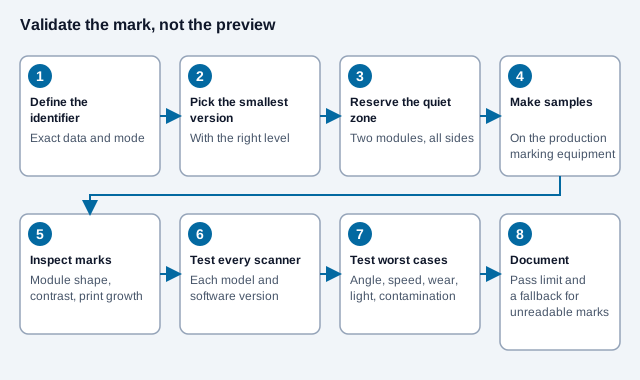
- Define the exact identifier and data mode.
- Select the smallest supported version with suitable correction.
- Reserve the full two-module quiet zone on every side.
- Create samples with the production printer or marking equipment.
- Inspect module shape, contrast, surface distortion and print growth.
- Test every scanner model and software version used operationally.
- Test worst-case orientation, speed, lighting, wear and contamination.
- Document an acceptance threshold and a fallback for unreadable marks.
Do not validate by enlarging a sample on a monitor if the production mark will be laser-etched, inkjet-printed, curved, reflective or only millimeters wide. The physical process is part of the system.
What mistakes cause Micro QR rollouts to fail?
Consider a team that proofs a Micro QR label on a laser printer, approves it, and later moves production to a thermal transfer line with a coarser dot. The printed modules grow slightly, the narrow quiet zone starts to touch the label border, and the shop-floor scanner, which was never switched to read Micro QR, returns nothing. Three separate assumptions failed: the proof matched production, the scanner knew the symbology, and the margin survived layout changes. Each shows up as a missing read, and none is visible on screen.
- Testing only with a phone and concluding the whole fleet will read it.
- Letting a label template shrink the two-module margin.
- Choosing a version by the visible text length without checking mode and level.
- Mixing Micro QR and standard QR on one product line with no operator cue.
Can this website generate Micro QR Codes?
This site's standard generator creates ordinary QR Codes for broadly compatible phone scanning. It should not label a symbol as Micro QR unless the encoder implements the Micro QR specification and the output has been verified with suitable readers.
For a customer-facing URL, use a short payload and a standard QR Code, preserve its four-module quiet zone, print it large enough for the viewing distance, and test the final artwork with the scannability tester. For industrial Micro QR deployment, use standards-conformant tooling and a documented verification process. You can start a standard code with the free QR code generator.
Where does Micro QR support still vary?
The text above does not settle which ISO/IEC 18004 edition your specification cites, whether a given phone model decodes Micro QR, or whether a particular regulated product permits it. Those depend on your jurisdiction, trading partner and equipment. This guide is general information, not legal, regulatory or engineering advice, so confirm requirements with the relevant standards body and your compliance team before marking regulated goods.
References
- DENSO WAVE: Micro QR Code capacities and standardization
- DENSO WAVE: rMQR Code
- DENSO WAVE: types of QR Code
- DENSO WAVE: QR Code standards overview
- DENSO WAVE: examples of problems encountered in reading a code
- Scandit: Micro QR Code
- Accusoft Barcode Xpress: Micro QR description
- Google ML Kit: barcode scanning supported formats
- GS1 US: barcode readability for the Drug Supply Chain Security Act